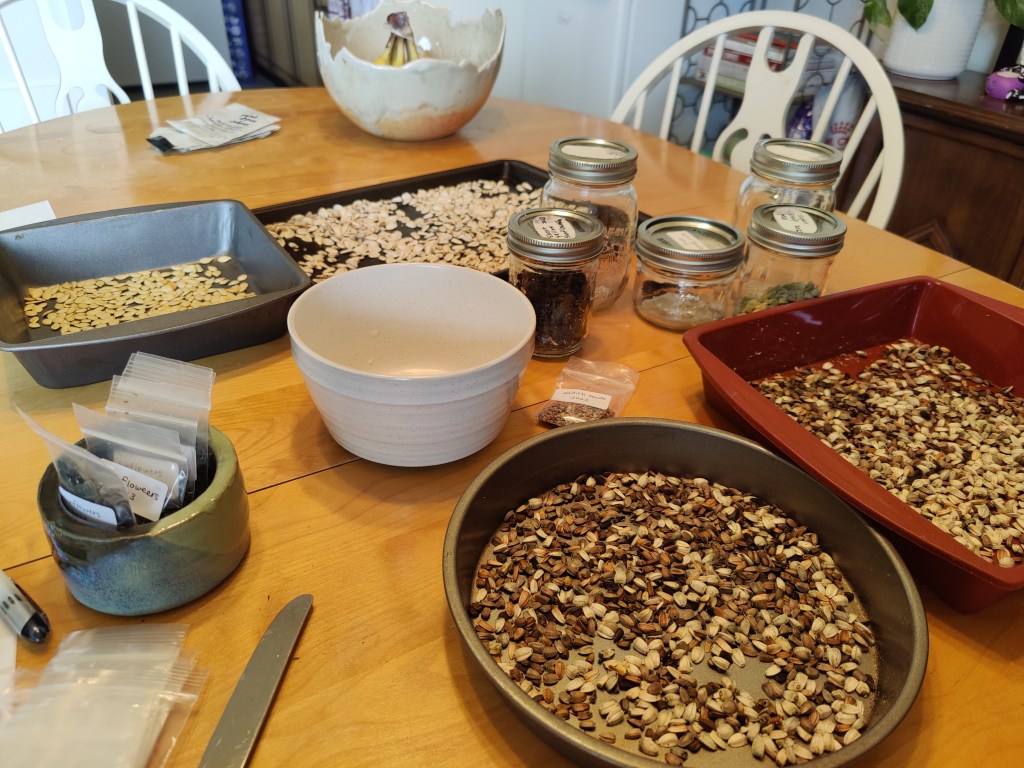
As I’ve started to grow more plants over the past couple of years, I’ve also started to save more seeds. In my experience, 2023 was a pivotal year for seed saving. I wasn’t available to pick all of my vegetables throughout the summer. Luckily that autumn I learned about the importance of saving seed, but also about the benefits that come with it.
Why is Seed Saving Important?
1. Preserves Biodiversity
- Over the past century, 75 percent of global crop diversity has been lost, according to the Food and Agriculture Organization (FAO)1. This decline is primarily due to the rise of industrial agriculture, which favours a small number of high-yield crop varieties over traditional, diverse species.
- When farmers save seeds, they preserve heirloom and indigenous varieties, which are often more resilient to local conditions and less dependent on synthetic inputs like fertilizers and pesticides.
2. Promotes Self-Reliance
- A few large corporations dominate the global seed market, controlling an estimated 60 percent of commercial seed sales2. These companies often prioritize patented hybrid and genetically modified (GM) seeds, which cannot be saved or replanted by farmers without violating intellectual property laws.
- This concentration of control reduces farmers’ autonomy and makes them dependent on purchasing seeds annually, which can be costly and unsustainable.
3. Safeguards Against Future Challenges like Climate Change
- As weather patterns shift and extreme conditions become more common, traditional crop varieties may no longer thrive. Locally saved seeds often represent genetically diverse and climate-resilient crops that can adapt to changing environments.
- Seed saving helps create a reservoir of traits—like drought tolerance or disease resistance—that can be vital for future food security.
4. And Safeguards Against Other Food Security Risks
- The global seed supply is vulnerable to disruptions, such as natural disasters, geopolitical conflicts, and corporate policies. For example, monoculture farming increases the risk of widespread crop failure if a pest or disease targets the dominant variety.
- By saving seeds locally, communities build a decentralized and more resilient seed system, reducing reliance on a fragile global supply chain.
Cultivating a Resilient Future Through Seed Saving
- Governments and NGOs are addressing the global seed crisis by promoting seed-saving practices and establishing seed banks, such as the Svalbard Global Seed Vault in Norway. However, reliance on centralized systems alone is insufficient.
Grassroots efforts, like community seed libraries and farmer exchanges, are essential to protecting local seed varieties and empowering farmers.
Seed saving is not just about gardening—it’s about preserving our collective future. By protecting seeds, we safeguard biodiversity, strengthen food systems, and ensure that we can meet the challenges of a changing world. Not to mention, it’s free!


Leave a Reply